
You don't need more features. You need proof. If you're searching for mvp development services, you're usually in one of two places: you have a product idea you want to validate quickly, or you have a proven service and you want to productise it into software that scales without adding headcount.
The right MVP gets you to real user behaviour fast. It turns your biggest risks (pricing, onboarding, workflow fit, integrations) into testable assumptions, and it gives you a build plan that stays simple enough to ship.
What is an MVP (Minimum Viable Product)?
An MVP is the smallest version of a product that delivers real value to a specific user by solving one clear problem. It is built to test demand and usability with real users, using measurable outcomes instead of opinions.
MVP development services are the professional services that help you plan, design, build, and launch that MVP - typically covering discovery, UX/UI, engineering, testing, deployment, and the measurement loop that guides what to build next.
When MVP development services are the right move (and when they are not)
Paying for an MVP is a smart decision when speed and learning matter more than polish.
You are a good fit if:
- You can describe a clear business problem in one sentence.
- You have access to real users (customers, internal teams, partners) within weeks.
- You need a reliable, secure build, not a one-off prototype that collapses at launch.
- Your product relies on workflows, data, and integrations that no-code cannot handle cleanly.
An MVP is not a cheaper full product. It's a focused experiment that becomes a real platform only after it proves demand.
What a good MVP looks like in practice
Most MVPs fail for one reason: they try to be impressive instead of useful. CB Insights' analysis of failed startups repeatedly highlights lack of market need as a top reason products die. A bloated MVP often hides that truth until you've already spent the budget.
A strong MVP has three traits.
1) A single "thin slice" workflow
Pick one end-to-end journey that delivers value in under 5 minutes of user time. Examples:
- Upload and validate a document, then produce one compliant output.
- Create a job request, route approvals, and schedule one action.
- Import a spreadsheet, reconcile it, and generate a single report.

2) A measurable success metric
Choose one number you can track from day one:
- Time saved per task
- Conversion from trial to activated user
- Percentage of tasks completed without help
- Weekly active teams
3) Deliberate constraints
A great MVP says "no" on purpose. Common constraints that keep you shipping:
- One primary user role (add admin later)
- One data source (integrations later)
- One region (multi-currency and VAT later)
- One billing model (usage-based later)
A real-world example of focus paying off
In Make IT Simple's Octopaye project, the team replaced an Excel-heavy payroll workflow that processed roughly 1,000 timesheets in about 45 minutes. The delivered platform ran 15,000 timesheets in under one minute. That is the compounding effect of building the right workflow first.
What you should get from an MVP development service
When you're comparing providers, ignore glossy pitch decks. Ask for deliverables.
Product discovery outputs
Discovery is where you buy down risk. You should leave discovery with:
- A crisp problem statement and target user definition
- A prioritised backlog using a simple framework (MoSCoW or RICE)
- A "definition of done" for the MVP release
- A release plan that names what will be cut if time runs tight
If discovery ends with only "a list of features", you are paying to guess.
UX and prototyping outputs
Your MVP should be designed to be used, not admired. Look for:
- User flows and wireframes for the thin slice workflow
- A clickable prototype you can test with real users
- A lightweight design system (buttons, forms, tables) to keep UI consistent
- Accessibility and usability basics baked in early
Engineering outputs
Ask how they will keep the MVP shippable.
- A working application deployed to a production-grade environment
- Automated tests for the critical workflow
- Basic observability (logs, error tracking, key events)
- A maintainable architecture you can extend after launch
The process that ships: discovery, two-week sprints, and ruthless scope control
The fastest teams do not move fast by rushing. They move fast by removing ambiguity.
At Make IT Simple, the delivery model blends upfront planning with two-week sprints so you can see progress regularly while still protecting the timeline with clear milestones.
Step 1: Align on outcomes before features
Start with outcomes:
- What changes for the user after the MVP exists?
- What manual work disappears?
- What decision becomes easier?
Then translate outcomes into the smallest set of features that create that change.
Step 2: Build the thin slice end-to-end first
This is the most counterintuitive part for many founders.
Instead of building "all of admin" or "all of onboarding", you build a complete journey that works:
- Data in
- Processing
- User action
- Output
- Feedback capture
You get a usable release earlier, and you learn sooner.
Step 3: Instrument the MVP like a product, not a project
Your MVP needs measurement from day one:
- Activation event (the moment value is felt)
- Drop-off points in onboarding
- Time-to-value
- Feature usage
Without this, post-launch becomes guesswork.
Step 4: Release, learn, iterate
An MVP launch is not the finish line. It's the first time your assumptions face reality.
Expect to discover:
- Users misuse fields in ways you never predicted
- One "small" edge case blocks adoption
- The real buyer is not the main user
- The integration you postponed becomes urgent
A good partner plans for these realities, instead of acting surprised by them.
Tech decisions that keep an MVP simple without painting you into a corner

Choose a boring, scalable baseline
For most B2B MVPs, a well-structured modular monolith beats microservices:
- Faster to build and test
- Easier to deploy
- Less operational overhead
- Still scalable if the modules are clean
You can split services later when usage proves it is worth the complexity.
Decide early: single-tenant or multi-tenant
If you are building SaaS, multi-tenancy affects almost everything:
- Data model and permissions
- Billing
- Reporting
- Support tooling
If the MVP is for one anchor customer, a single-tenant launch can be the right call. Just make the migration path explicit.
Treat security as scope, not a bolt-on
Security and compliance are not optional once you store customer data.
The average global breach cost can land in the multi-million range. Even if your product is early, basic controls are cheaper than recovery.
Minimum security for most MVPs:
- Role-based access control
- Audit logs for critical actions
- Encryption in transit and at rest
- Secure credential storage
- Regular dependency updates
Use AI where it creates measurable value
AI features are easy to demo and hard to maintain.
A sensible MVP use case is narrow and auditable:
- Search across internal knowledge (RAG knowledgebase)
- Automated document classification with human review
- Drafting summaries with clear source links
If AI is the product, treat evaluation and monitoring as first-class features from day one.
Cost and timeline
The fastest way to waste money on an MVP is asking for a fixed price before scope is clear. The second fastest is agreeing to a time-and-materials build with no delivery definition.
A trustworthy quote ties cost to outcomes and constraints.
What drives cost up (and what you can control)
You pay more when:
- You need iOS and Android at launch, not just web
- You require multiple integrations (CRM, payroll, accounting, SSO)
- You are migrating messy legacy data
- You need heavy compliance (healthcare, finance, SOC 2 readiness)
- You have complex permissions and approval chains
You control cost by cutting surface area:
- Start with web-first unless mobile is essential
- Replace integrations with CSV import for the MVP
- Limit roles to one user and one admin
- Choose one billing model and one plan
A practical way to think about timelines
Most focused B2B MVPs fall into three buckets:
- Lean MVP (4-8 weeks): one workflow, minimal integrations, web-first
- Core MVP (8-12 weeks): workflow plus one integration, basic admin and reporting
- Complex MVP (12-16 weeks): multiple roles, permissions, integrations, or compliance-heavy needs

How to choose MVP development services that actually deliver
Your provider is not just writing code. They are shaping your first version of product-market fit.
Transparent delivery and communication
You want:
- A named product owner or delivery lead
- Weekly demos and a visible backlog
- Clear acceptance criteria for each sprint
- A shared definition of done
A plan for the day after launch
Good MVP development services include:
- Bug fixing window after release
- A performance and reliability baseline
- A backlog refinement session driven by data and feedback
- Ongoing support options if the MVP takes off
Proof that they have done it before
Look for examples where software replaced manual work and unlocked scale.
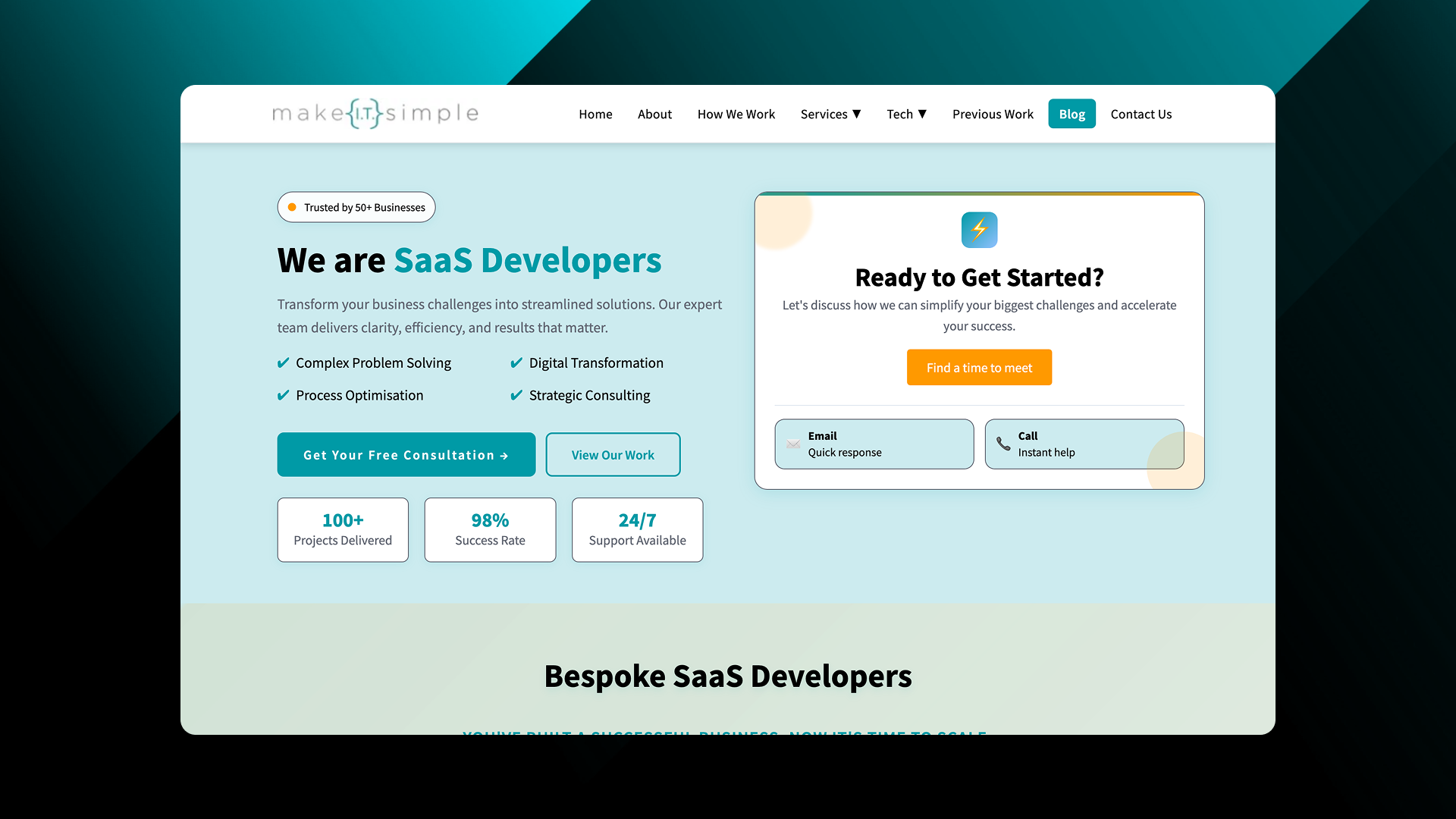
Make IT Simple's previous work includes web platforms built to remove spreadsheet-heavy admin, reduce errors, and increase capacity - the exact value most founders want from an MVP.
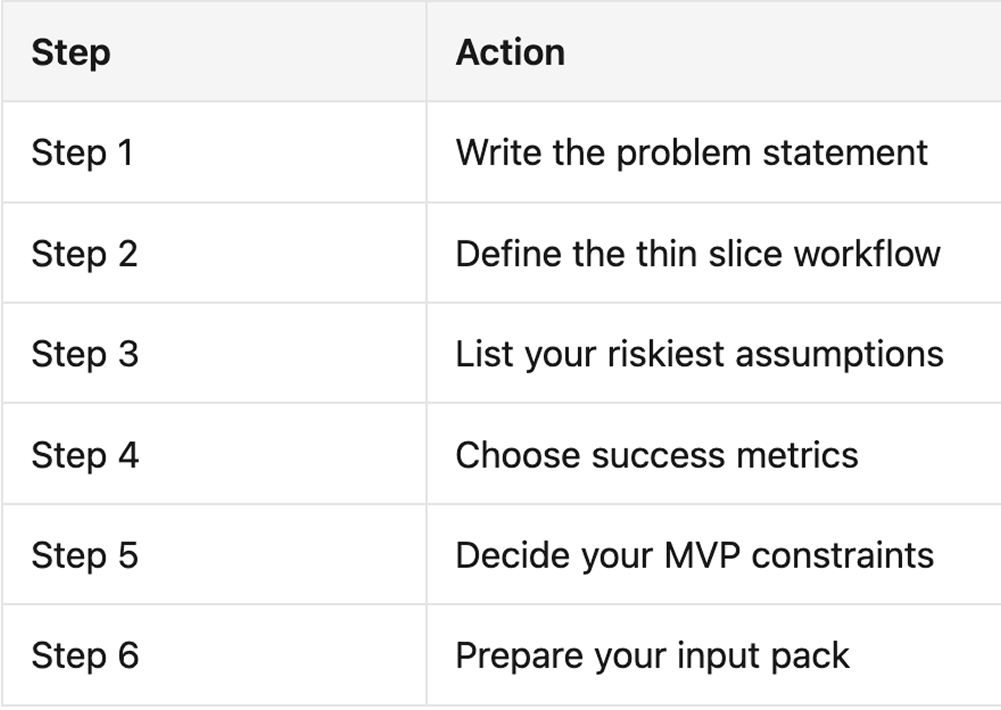
Practical application: your 60-minute MVP brief
If you spend one hour on this, you will save weeks of meetings and rework.
Conclusion
MVP development services are worth paying for when you need speed, clarity, and a build that can survive contact with real users. The win is not launching an app. The win is learning what drives adoption, cutting the noise, and turning your expertise into a product that scales.
If you want to move fast without gambling on the wrong scope, start with a thin slice workflow, instrument it properly, and choose a partner who will challenge your assumptions as hard as they build your features. When you're ready, share your MVP brief and you can get a clear plan for the quickest path to launch - whether that's a web app, mobile application, desktop tool, or a custom SaaS platform built for recurring revenue.
FAQ
How long do MVP development services take?
A focused MVP can ship in 4-12 weeks when scope is tight and the workflow is clear. Timelines stretch when you add multiple roles, integrations, mobile platforms, or compliance requirements. The best teams protect speed by cutting surface area, not by cutting quality.
How much do MVP development services cost in the UK?
Cost depends on team size, platforms, integrations, and compliance. A web-first MVP with one core workflow is usually far cheaper than a multi-platform build with complex permissions. The fastest way to get an accurate number is a short discovery phase that locks scope and acceptance criteria.
Should you build an MVP with no-code first?
No-code is excellent for validating landing pages, waitlists, and simple internal tools. It breaks down when you need custom workflows, robust permissions, complex data models, or performance you can rely on. Many teams start with no-code for demand signals, then rebuild the validated workflow as software.
Do you need a product manager for an MVP?
You need product ownership. That can be a founder, a dedicated PM, or a partner who provides product leadership alongside engineering. The key is one person accountable for scope, priorities, and success metrics. Without that, MVPs drift into feature builds, decisions stall, and timelines slip.
What happens after the MVP launch?
Post-launch is where value is created. You measure activation, fix the blockers users hit, and iterate toward product-market fit. Most teams also add foundational pieces like billing, admin tooling, and integrations once demand is proven, because those investments compound only after users care.